


As the Week van de Circulaire Economie begins, we would like to share how we approach sustainable business at Cirmar. For us, the circular economy is not simply a goal to work towards — it is the starting point and reference framework for how we design systems.
Instead of improving linear systems, we focus on creating circular alternatives that preserve material value and reduce waste by design. This means designing products, logistics, and recovery processes together as part of one coherent system.
Our approach can be visualized as a circular loop.
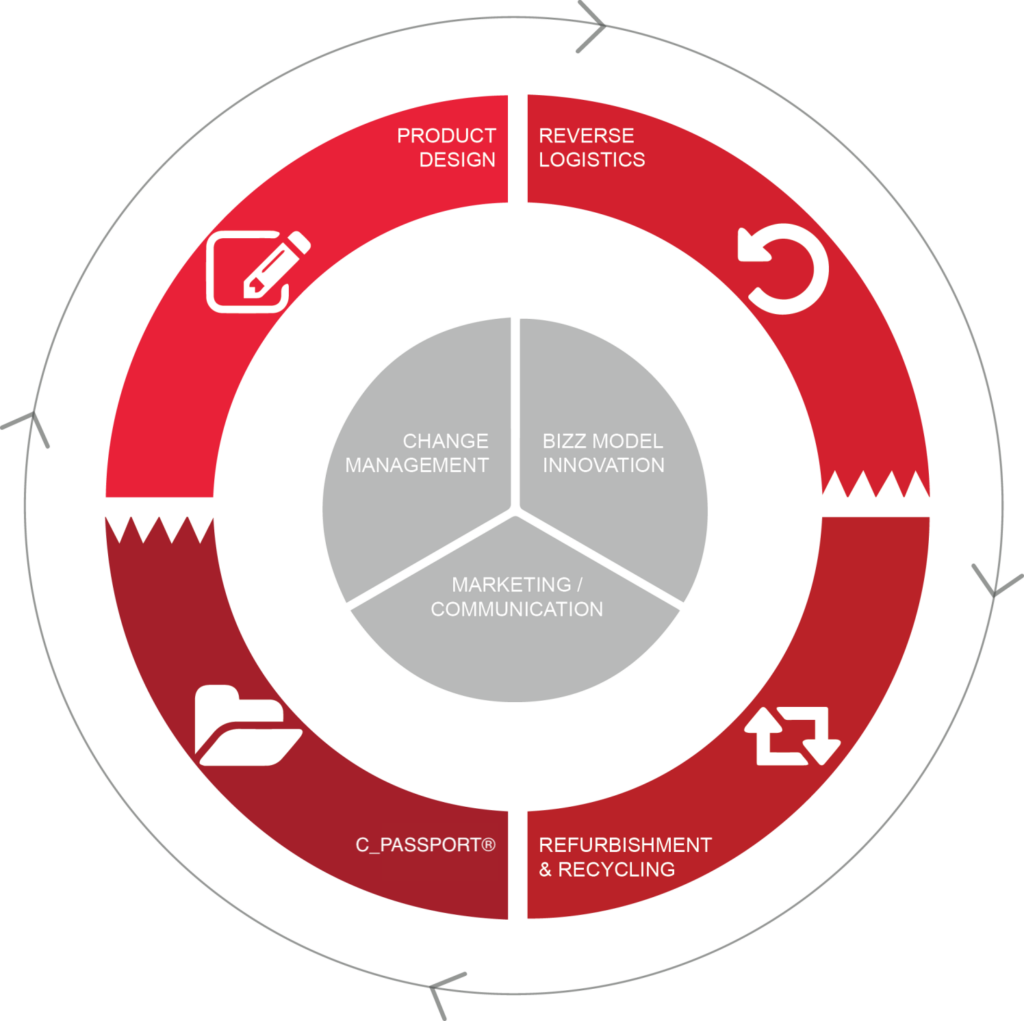
It starts with product design, where materials and components are selected with future recovery in mind. Products should not only perform well during their use phase, but also remain valuable at the end of it.
To enable this, reverse logistics ensures that products and materials can flow back through the value cycle rather than becoming waste. Once recovered, products and components can be directed toward refurbishment, reuse, or recycling, depending on what preserves the highest value.
A crucial enabler in this system is C_passport®, our Digital Product Passport platform. By recording the material composition of products, automatically calculating circular impact, and identifying the most valuable end-of-use pathways, C_passport® helps ensure that circular design choices remain visible and actionable throughout the entire lifecycle. In this way, circularity is not lost once products enter the market — it is locked into the system.


However, implementing circular systems requires more than technical solutions. At the center of our model are three enabling dimensions:
Together, these elements form a system where materials retain their quality and value for as long as possible, and where circular solutions outperform their linear counterparts. Cirmar believes the fundamental decision to be made (and we already did) is to focus on volume. By creating insights and closing loops of as many materials as possible, we can accelerate this crucial circular transition. In other words: let’s start organising the first 90% of the transition and prove that we can do better than linear!
Lesson of the day:
Circularity works best when it is approached as a system, not as an isolated intervention.
Throughout this week, we will share more insights from our work on how organizations can design and implement circular systems in practice.
Stay tuned for tomorrow’s insight.